

STEM By Design
Frameworks that Elevate STEM Education.
All students are capable of success in STEM when teachers begin with a supportive mindset and a belief in their potential.
Designing learning that is authentic, engaging, and accessible creates an opportunity for every learner to explore with confidence and thrive in a meaningful learning environment.
Here are some frameworks that drive my approach to designing learning experiences.

Project-Based Learning
A teaching method where students gain knowledge and skills by working on a real-world problem or question over an extended period of time.

Universal Design for Learning
A research-based framework from CAST that helps teachers design flexible learning environments to meet the diverse needs of all learners.

I do, We do, You do
A teaching framework that shifts learning responsibility from the teacher to the student through three stages: I do, We do, You do.

Sources of Self-Efficacy
A theory that explains how people develop belief in their ability to succeed through: Mastery Learning, Vicarious experience, Social Persuasion and Emotional state.
Guitars Rocketry & Robotics
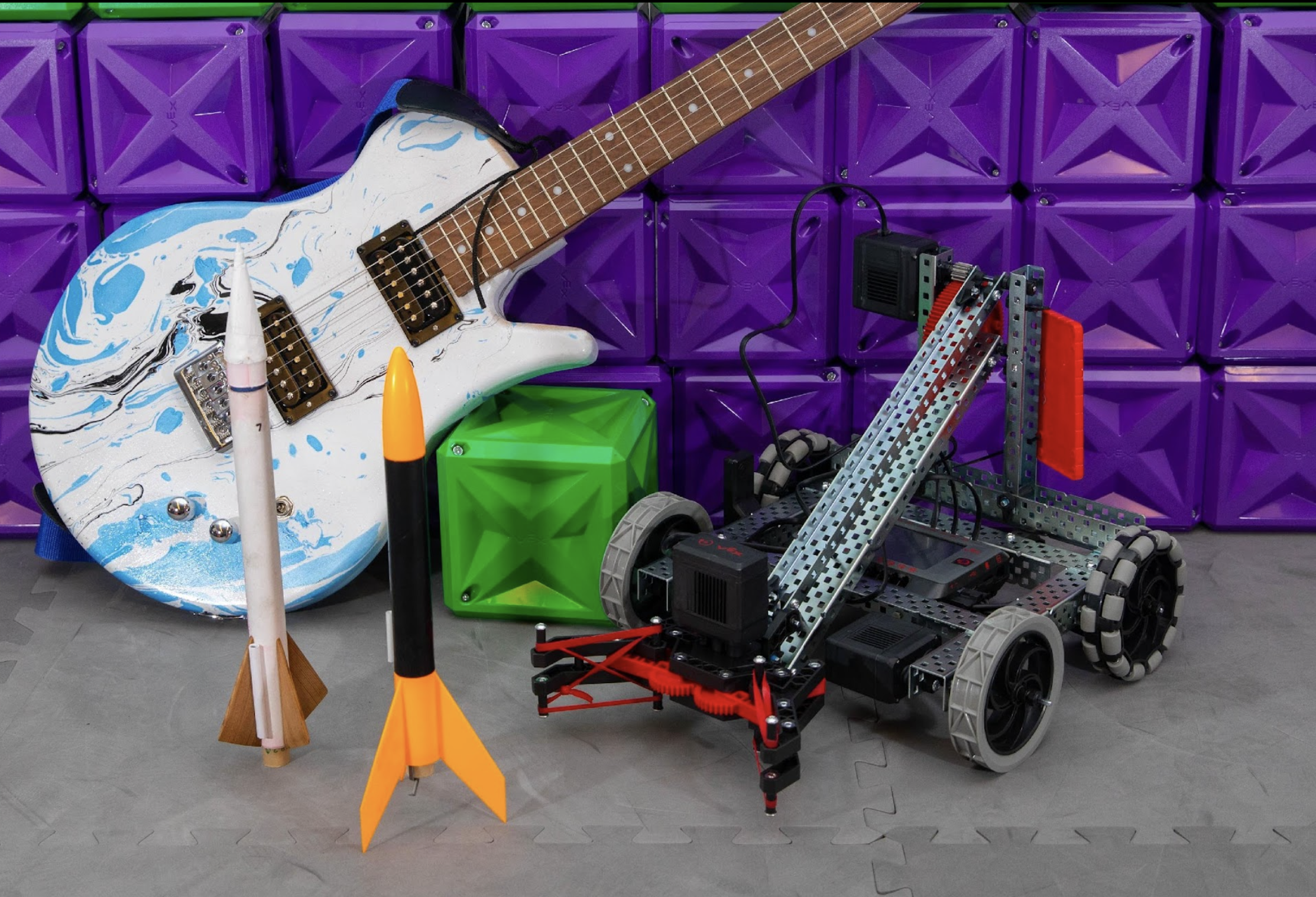
GRRATE is is funded by the National Science Foundation Advanced Technological Education grant award #2201539. It is a hands-on, project-based class that uses guitar building, rocket launching, and robot design to encourage underexposed students to consider coursework and careers in STEM.
Design Product Portfolio
A collection of animation, images, video and resources which have been produced and incorporated into past lectures for educational technology enhanced classroom environments. The video library includes a demonstration of Newton’s Laws of Motion, an animated diagram of gravitational force and experiential model demonstrations of guitar body engineering.
Online Canvas Course Designs
- Robotics Course Template
- ISC1006 E-Guitar Engineering
- ISC1006 Rocketry Engineering
- ISC1006 Robotics Engineering
Multimedia Video & Visual Diagrams
Educative & Resources
Teacher Support
Time for CS is a grant-funded project to support in-service teachers’ pedagogy in K-12 Computer Science. The series of mini-lecture videos were produced and animated with EDU Powtoon and Camtasia video production software. https://timeforcs.org/videos/
Online Video
This video is a support in a fully online CS Foundations Course module to support understanding the theoretical concept of self-regulation and how is applied in learning context.
ScreenCast Support
This video is a screencast demonstration using Camtasia video production software. The instructional video models how to get started using Scratch programming platforms for K-12 computer science teachers.
Tech Reflections
LATOYA CHANDLER, PhD.

The VEX+AI unit reinforced for me that AI literacy is not about advanced algorithms for robots; it is about agency. When children realize that they are responsible for their robot’s intelligence, they begin to see AI as something human-made, shaped by decisions and choices—and therefore something they have the power to understand and influence.
Latoya Chandler
Additional Publications
Projects
Educational Projects

Summer Institute Rocketry
Participatory learning communities, collaboration tools, and more.
contribution
Instructional Design Solutions for designing, building and launching a model rocket product.
Availability
This institute is offered once a year, in the summer for high school students at Santa Fe College center locations Archer, Gainesville, Keystone Heights, Alachua, and Starke, Florida.
description
Guitar, Robotics, and Rocketry Projects to Enhance Advanced Technological Education (GRRATE) lesson unit, was designed implemented by LaToya Chandler and provides information on project-based learning. The lesson toolkits highlight a fully in-person rocketry micro-unit.

Robotics + AI
The lesson unit is a hands-on robotics module designed to build foundational knowledge of AI literacy through computational thinking and robotics.
aim
Because teachers coordinate how the students will implement the programming process, researchers co-designed an existing VEX robotics lesson unit with in-service teachers focused on the Ai4K12 big idea of perception.
description
The core of the unit is centered around the VEX Robotic’s Mars Roving activity where students will explore life on a new planet. Students explore the robot’s sense to understand how machines sense and interpret the world around it.
 human-centered Design in stem education